


Plans for the Future
- Academics
- Continue highly successful faculty seminars on integrating sustainability into the curriculum . To date over 70 faculty from 21 different departments have participated in the workshop and more than 70 courses at the University have now been infused with at least one sustainability component.
- National Leader in Faculty Development . With appropriate collaboration and University-wide support, one can imagine The University of Scranton as the host site for regional or national Education for Justice development workshops with an array of expert speakers and guests. We look to Education for Justice: The Case for Sustainability as a critically important first step in the journey to situate The University of Scranton as a leader in educating students, and as a place that develops and encourages those who wish to serve as leaders in this and other education for justice projects.
- Develop an interdisciplinary Professional Science Master’s degree in Sustainable Technologies Administration. The Professional Science Masters Program (PSM) in Sustainable Technologies Administration (STA) at The University of Scranton will provide graduates with a firm knowledge of sustainable technologies and sustainable business practices. A unique blend of courses will educate individuals who can chart a course and steer organizations toward sustainability. These individuals will specifically be trained to develop and implement short and long term sustainability and energy plans (SEP).
- Physical Plant
- Recycling Program . Evaluate our recycling initiative on campus and make improvements where we can. Include in this renewed program an emphasis on recycling of computer equipment and integration of recycled materials and sustainable building products.
- University Architectural & Engineering Services . Contract with architectural and engineering firms that employ sustainability in design and selection of materials and equipment for use in University buildings. Encourage the use of recyclable materials in all projects. Encourage the use of geothermal technology and heat recovery in heating and cooling systems. Increase building density when possible (i.e. multiple story buildings as opposed to low rise construction). Encourage the use of passive solar systems and solar shielding through building orientation.
- Transportation . Investigate ways to use hybrid and other fuel-efficient vehicles as University fleet cars.
- Staff Education . Commit to sending individuals from the physical plant staff to educational seminars nationwide in order to remain current on sustainable issues.
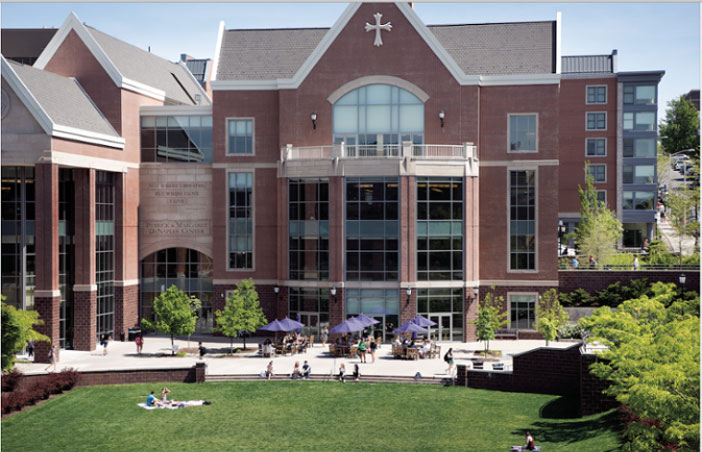
- Future Building . Continue our commitment to incorporating sustainable materials and methods of construction in new or renovated University facilities as we have done with Condron Hall, the DeNaples Center, and the Unified Science Center (under construction). Include the requirement for EnergyStar rated equipment in all project plans. Identify projects that provide savings in energy consumption such as lighting retrofits, variable speed drives, etc. Investigate the integration of new technology to further reduce our dependence on energy provided by fossil fuels. Investigate ways to use natural lighting in new facilities. Investigate ways to use solar and wind power for augmenting electrical systems. Use more energy efficient windows (i.e. triple glazed) in facilities. Increase insulation values in building envelopes in renovation projects. Investigate the use of recovered storm water and grey water systems for irrigation and landscaping. Incorporate the use of landscaping materials to assist in tempering buildings and minimizing the amount of storm water in the storm water systems.
- Environmental Purchasing Criteria . Give preference to products that use fewer hazardous materials, are more energy efficient, generate less waste, incorporate more recycled materials, and are themselves more easily recycled.
- Water Conservation . Implement a program for water consumption that will save approximately $90,000 annually in water use, sewer costs, and thermal energy costs.
- Dining . Continue efforts to reduce food waste in the DeNaples Center and in catering services by developing a food recovery program in partnership with local non-profit organizations.
- Composting . While excess food waste can never be totally eliminated, it could be put to better use through a coordinated composting program. The University has already worked with local and state officials in a beta composting effort off-site and has started discussions regarding an on-site composting initiative.
- Community Education
- Awareness Campaign . Expand awareness on the importance of this issue through Earth Week events, community forums, and other mechanisms.
- Student Programming . Build sustainability into student programming through Residence Hall programs and student clubs and organizations.
- Speaker Series . Continue hosting outside speakers on the issue of sustainability. Both the entire University community and the greater Scranton community are invited to attend and participate. These sessions serve as a way to educate people on this issue and keep it top-of-mind. Continue to plan these events in conjunction with Earth Day observances.